
Old habits don’t disappear just because you decide to change. They return because they are built on repetition, emotional memory, and identity-level programming.
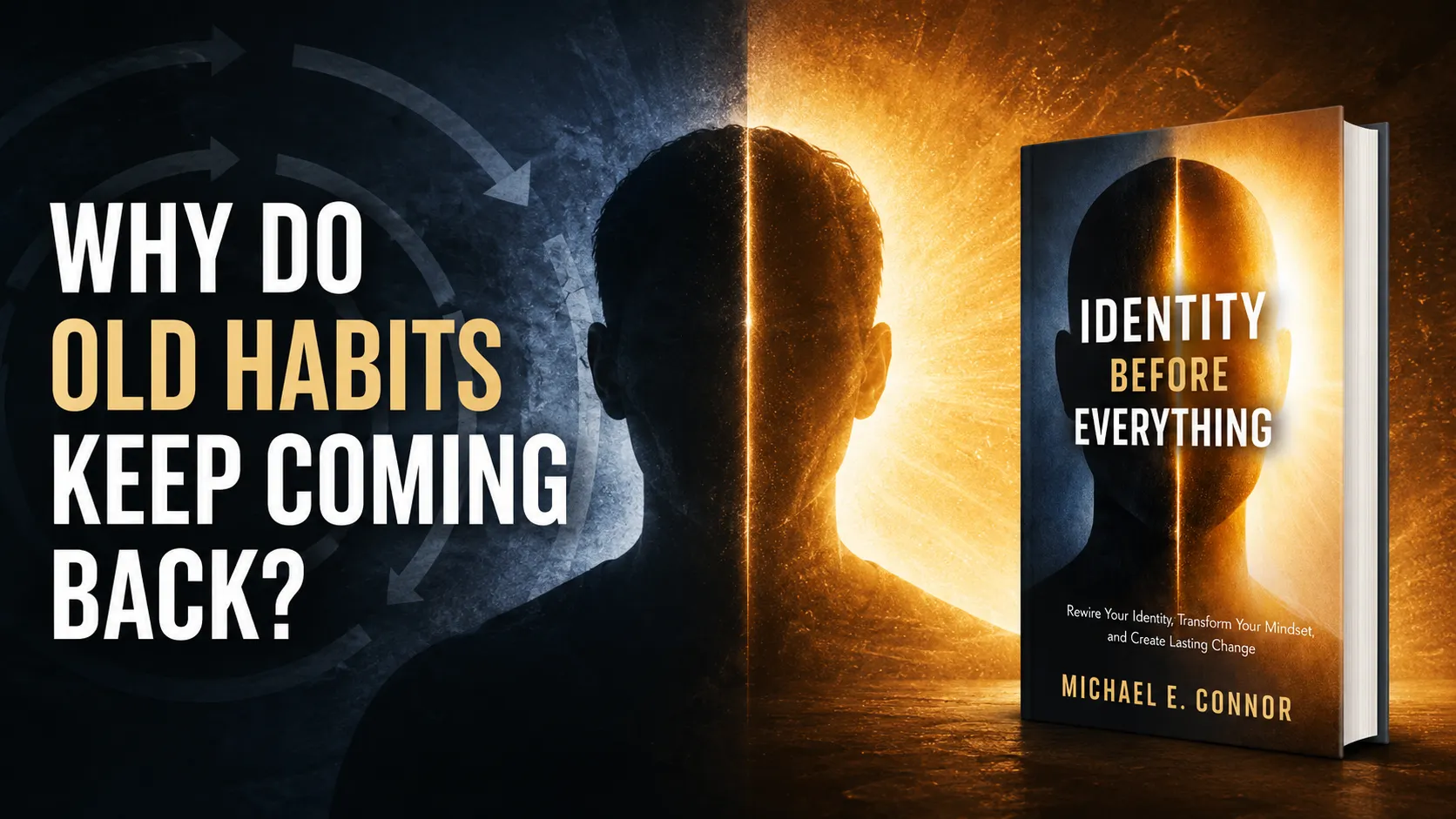
This is the core idea in Identity Before Everything by Michael E. Connor, in which behavior is explained as a surface output of deeper identity patterns that recur automatically over time.
You are not dealing with a random relapse. You are dealing with a system that defaults to what is most familiar.
The Brain Does Not Care About Your Intentions
Your brain isn’t committed to your ambitions. It is committed to efficiency. Whatever uses less energy wins.
Old habits are effective. They are automated, tested, and predictable. New habits are pricey. They take concentration, emotional effort, and repetition.
This is where repetition and emotional familiarity become the real deciding factor. You do not form a habit because it is “better.” You accept it because your nervous system has enough experience with it to feel comfortable.
If it does not feel familiar, your system considers it unstable, even if it is healthier.
Habit Relapse Psychology is Not Failure, it is Default Behavior
Most individuals connect relapse with weakness. That is wrong.
Habit relapse psychology is straightforward: when stressed, the brain abandons novelty in favor of what is most familiar.
When the pressure rises, your prefrontal cortex weakens. This is when old tendencies take hold. Not because you “lost control,” but because control was never the most effective mechanism in place.
This is why willpower consistently fails in the long run. It is a temporary override, not a replacement system.
Dopamine is not Motivation, it is Prediction
People often blame dopamine as if it were a reward substance. That is incomplete.
Dopamine is a predictor. It fires based on expected results, not merely pleasure.
The brain knows the outcome, old behaviors enable dopamine to be released more quickly. There is no ambiguity. There’s no friction. There’s no learning curve.
New habits do not yet provide the same level of dopamine stability. So your brain keeps bringing you back to what it can anticipate with certainty, even if it kills you in the long run.
That is why you don’t “feel like” doing the new thing, even though you know it is better.
Comfort Zone is Not Comfort, it is Familiarity
The comfort zone is deceptive. It is not a matter of comfort. The goal is to lessen cognitive stress.
Your brain loves conditions that require little effort and are easy to predict. This is why it keeps repeating old behaviors. They necessitate less cognitive effort, emotional uncertainty, and adaptation.
New behavior is uncomfortable, not because it is incorrect, but because it is untrained.
When people say “I keep going back to my comfort zone,” they really mean: “I keep returning to what my nervous system has fully mapped.”
Why New Habits Don’t Survive Early Stages
New habits fail at the start for three reasons:
First and foremost, they have not yet achieved emotional stability. You are pushing conduct that is not emotionally aligned.
Second, they lack repetition when stressed. Practicing when things are easy does not count. The brain rewires itself under duress, not in luxury.
Third, there is a battle over identity. Part of you is still your “old self,” which has stronger wiring. So the system turns back. Not at random, but in logical order.
How New Habits Actually Become Stable
There is just one method that works: repetition till emotional familiarity overcomes resistance. It is not just the repetition of actions, but also the repetition of emotions. You must train your perception of the new identity until it no longer feels new or foreign.
This is the stage at which relapse begins to reduce. Not because temptation has vanished, but because the old pattern no longer feels dominant or inherently appealing.
The Uncomfortable Truth
If old habits return, it is not due to a lack of discipline, but because you are attempting to overwrite your identity rather than recreate it. That strategy never works in the long run. You don’t conquer old habits by battling them.
Instead, you replace them with repetition powerful enough to obliterate emotional memories. Until that happens, relapse is not an anomaly; it is merely the system functioning as intended.